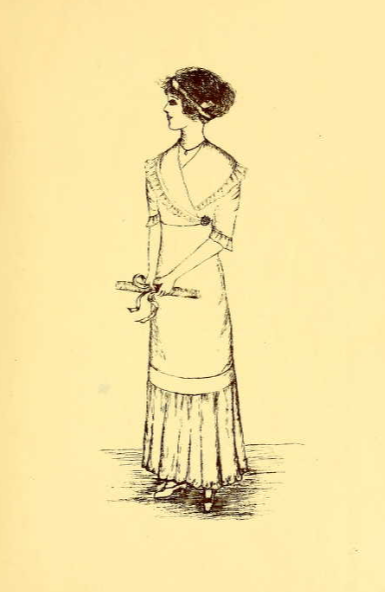
Sketch of the ideal student. The School Ma’am, 1912.
When we imagine the typical student who attended “the Normal,” we picture a young woman in a long, white dress, quite literally a “straight-laced” figure in a corset, a goody-goody future school teacher. The institutional narrative, written overwhelmingly by men to persuade other men to send their daughters here, stresses a particular kind of Southern white womanhood. The actual young women who enrolled in the early 20thC often resisted social conventions, however. Most of the time, they merely pushed back gently on the structures. But in a few cases, they committed egregious enough offenses to be intentionally erased from the picture. This is what happened to Lillian Campbell, who
broke the school’s moral code when she defied her father and her substitute father, President Burruss, by eloping in 1913. Read on to learn why she bore the blame and how reclaiming her story helps us understand a hidden part of institutional history and culture.
“That our daughters may be as cornerstones, polished after the similitude of a palace.”
Mission statement, Bulletin of the State Normal and Industrial School for Women at Harrisonburg (1909)
Young Lillian, described as a “beautiful blonde,” grew up in Bedford, Virginia, where she fell in love with a young man her father disliked. Her father, J. Lawrence Campbell, was a prominent lawyer, former state senator, and judge of the circuit court for Bedford and Franklin counties. Her beau, Thomas Davis Berry, came from an affluent family, too: his father, and uncle, and grandfather were all in tobacco. After his parents died in 1907 and 1909, however, Tom and his siblings were divided among various relatives. Perhaps Lillian’s doting father, a widower, doubted Tom’s prospects. When the couple got engaged, the Judge took more aggressive measures to break them up. He enrolled her as a special student at the Normal school in Harrisonburg in January 1913 at the start of the spring quarter. But her enrollment was temporary for he also promised to take the 18 year old to “Paris in April for study and travel.” Clearly, he was buying time, hoping that separation would change Lillian’s mind.1
I don’t know for certain that the Judge personally brought Lillian to campus, but it seems probable given the situation, and we can picture a tense scene as the Campbells met with President Julian Burruss. Burruss met with all new students as part of his in loco parentis duty. But he had approved Lillian’s sudden admission, so he knew she was a special case, a young woman with a mind of her own. The whole thing undoubtedly gave him pause.
We forget from the vantage point of 2025 how controversial the idea of a professional school for young women was in the 1910s. Many Virginians, including many powerful men, had to be persuaded their daughters would not be “unsexed” by too much education or independence. Burruss and his team of handpicked faculty all worked very hard to develop not only their students’ minds, but their moral character. The school’s mission statement, taken verbatim from Psalms 144:12, likened the young women to the ornamental columns of a great, ancient temple–strong and upright, yet beautiful.2 He would have apprised Lillian of the many rules that governed campus life, rules printed in a pocket-sized, YWCA-printed student handbook that he gave each new student for easy reference. He would have recorded her denomination, so he knew where she would attend mandatory church services on Sundays. And he would have stressed the school’s prohibition on seeing young men without permission and a chaperone. Perhaps he encouraged a new pastime, like hiking or poetry.
Lillian’s roommates helped her settle in after the Judge left. One of the other girls was none other than Tom Berry’s younger half-sister, Eloise, who was in her second year at the school.3 The Campbells obviously knew that 20-year old Eloise was there. Indeed, her presence indicates the Judge’s plan was more persuasive than coercive, and that Lillian was a willing participant–at least outwardly: “Ok, Daddy, I’ll give it six months, but if I still love Tom come summer, I’m marrying him.” Eloise helped Lillian unpack her trunk and showed her around the very small campus—just three buildings on a rocky former pasture then. Their room was located on the first floor of dormitory #2 (now Harper Allen-Lee Hall) and it was a triple. The third roommate’s name was Lillian Craig, and as the cold winter days passed, Eloise and Lillian brought her in on a new plan.
Around 6am on Friday, February 14, Lillian threw a bedsheet rope out her dorm room window, climbed down into Tom’s waiting arms, and ran off with him to get married. When discovered, her absence caused an immediate uproar. Every Normal student’s whereabouts were always strictly accounted for at every minute of every day, starting from the 6:30am waking bell. Her roommates covered for her. Still, Lillian would have been missed early, if not at the 7:45am common breakfast in the dining room, then certainly at her 8:30am class. Someone alerted Burruss, likely Mrs. Brooke, the dorm matron, whose job it was to monitor the residents’ behavior. Eloise and Lillian Craig were called in for questioning and revealed that Tom had secretly arrived in Harrisonburg the day before, February 13. The couple had fled on the first train out, bound for someplace where a quickie wedding could be had that very day, possibly Washington DC or Hagerstown, Maryland. It was all very shocking and incredibly romantic.
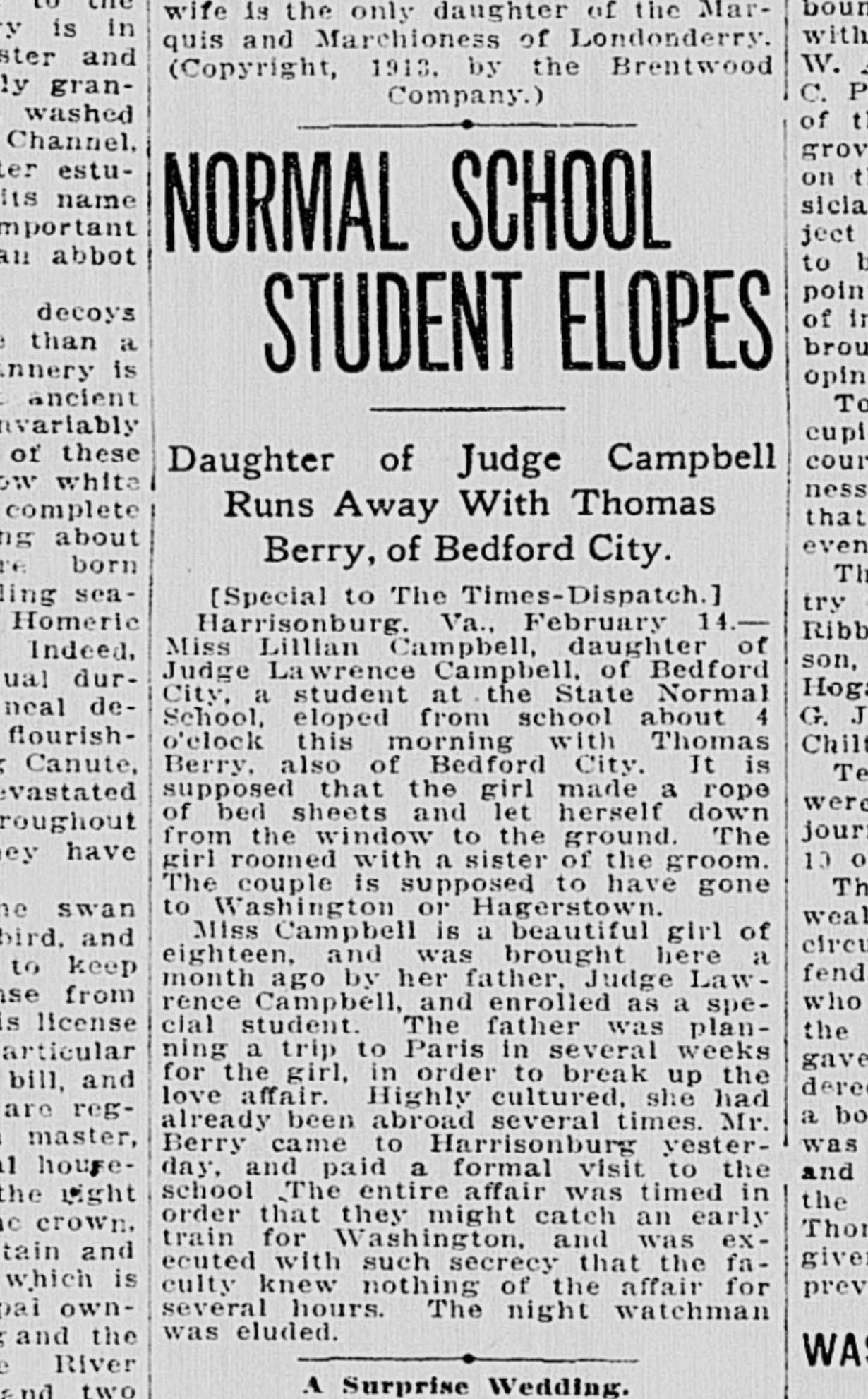
The Richmond Times Dispatch report of Feb. 15, 1913.
Burruss had a difficult day calling the Judge, investigating the situation, consulting his closest advisors on campus, and taking steps at damage control. He also scheduled a special all-faculty meeting late in the day to consider immediate disciplinary actions against Lillian Campbell and her accomplices. They convened at 4:50pm and talked for nearly seven hours, during which time they called in various witnesses and heard character references. The faculty met regularly to discuss problematic students, women who missed classes, suffered extreme homesickness, or behaved improperly, but this incident was unique. There was no rule in the handbook against eloping because no one had foreseen such a thing ever happening. Instead, they unanimously agreed to expel Lillian for breaking “the specific and emphatic rule . . . that no student is to leave the school without permission.”4 As a message to the other students, they compelled Eloise to withdraw “at once” and gave Lillian Craig a one-year suspension, effective immediately.5
The next day, headlines broke across the state, rippling out from Harrisonburg to Richmond, Newport News, Alexandria, and even Highland County. It’s not clear who talked to the reporters at first, probably Burruss because the early articles stress the “secrecy” the couple employed, noting “the faculty knew nothing for several hours” and that the “watchman was eluded.” In that detail especially we see someone at the Normal shaping the narrative: the night watchman was patrolling because it was still dark at 6am in February. Yet Lillian somehow climbed down “fifteen or twenty feet” without detection, and the couple managed to reach the train station without drawing attention of the campus employees already arriving for work in the dining hall. They left on the 6:40am train from Harrisonburg—the station master undoubtedly confirmed that fact. The Alexandria Gazette revealed the couple’s destination, Washington DC, where they went first to “City Hall” for a license, then to “413 4th Street NW,” the home of Rev. Lowrie, who performed the ceremony. (Clearly, the editor sent a reporter into the city to trace their route.) By contrast, The Richmond Times Dispatch emphasized her beauty and youth (only 18), and said she was “highly cultured,” noting she had been to Europe twice with her father and could speak several languages. Over the next few days, additional articles revealed Lillian’s expulsion and stressed not only that she left campus without permission, but she “violated the spirit of the honor system, upon which such emphasis is placed by this institution.”6
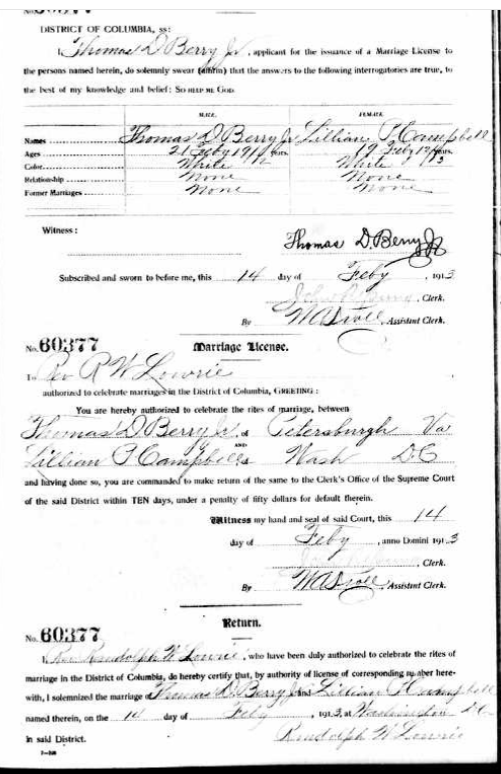
Scanned copy of the wedding register showing Thomas D. Berry, Jr.’s and Lillian P. Campbell’s license dated Feb. 14, 1913. Note they gave her age as 19, though she was only 18. Ancestry.com.
Reading between the lines, we see the school and its administration trying to put the blame wholly on Lillian. Tellingly, none of the sources, not even the private faculty minutes, suggest that Tom, who was three years older, persuaded her to disobey. That would have been an obvious explanation, a common trope, really, the ardent lover who lures the innocent young girl away. The reporters noted only that Tom “made a formal visit” to the Normal on February 13. Nor do they blame her widowed father for overly indulging or spoiling her, another handy stereotype. The Alexandria Gazette said Lillian had “to remain [at the Normal] until arrangements could be made to send her to Paris,” and that “the trip abroad was demanded by the Judge” to “break off the love affair.” The passive voice language there is quite exculpatory of the Judge, who gave no interviews that I’ve found. A “highly cultured,” well-traveled, beautiful 18-year old, Lillian was also sneaky, daring, a rule-breaker. (A darker implication is that she was, in the parlance of the day, fast.) By blaming her as an immoral individual, the Normal’s narrative reassured the public that this elopement was an isolated event, never again to occur. And after the story died down, they made it disappear.
For decades, this institution’s academic reputation required an insistence on feminine obedience, morality, and purity. The school’s leaders obviously understood that some of the young women had a strong interest in courtship, men, and marriage. That is why a matron lived in each dorm to monitor the young women and why parents had to approve any young men callers their daughters might attract. Over time, as US courtship rituals changed, alumnae scrapbooks, yearbooks, faculty minutes, and other materials steadily document increased incidents of students flirting with strangers, dating for fun rather than to find a spouse, staying out past curfew, riding unchaperoned in cars with men, and necking or petting in dark places. By the 1960s, stories about Madison College’s “kissing rock” implied a pervasive culture of romance, if not frisky behavior. Yet even then, a runaway bride went too far.
What happened to the newlyweds? Where they first lived is unknown, but it appears they eschewed Bedford. Notably, Lillian did not attend the Judge’s April 1914 funeral. She was perhaps unwelcome. (His obituary in the May 3, 1914, Richmond Times Dispatch notes the presence of his sons at the large, public funeral, yet adds, “He had a daughter, Mrs. T. D. Berry.”–as if she were dead.) It appears the Berrys lived first in Florida, where their first child arrived in December 1914. It was a girl they named Lillian Eloise for the aunt who helped them elope. Tom began his long career selling advertisements in newspapers, and the family moved frequently. In 1917, when Tom registered for the draft, they were in Cairo, Illinois, and by 1920, they were settled in Milwaukee. The 1920 census records four little girls: Lillian, born 1914; Elizabeth, born in Tennessee in 1917; Mary, born in Kentucky in 1918; and Virginia, born in Wisconsin just that year. Unfortunately, the marriage ended in divorce several years later.7 Perhaps the Judge knew best, after all.
By 1930, Tom Berry had remarried and was living in Gulfport, Mississippi, where he worked in sales for the New Orleans Times Picayune and started a new family. He and his second wife, Deborah, eventually had four children, including several sons. Tom evidently stayed put for thirty years, dying in 1968. (His obituary in Biloxi Daily Herald 27 Feb 1968 would be great to read.)
1930 federal census schedule showing Lillian Berry and her four children in Milwaukee. They rented an apartment, likely near the public library where Lillian worked.
Lillian remained in Milwaukee. The census taker who came to her door in 1930 found our ‘highly cultured’ woman living alone with her four daughters, raising them on her own as a single parent. She surely struggled to keep her girls together. Neighborhood housewives, public school teachers, church ladies, city social workers all would have watched her closely, assessing her fitness to be a mother, this divorced woman who eloped. Her occupation as “librarian” in one of the city’s public libraries helped; it was a respectable albeit low-wage job. Times were hard during the Great Depression, and she soon took in lodgers to make ends meet. When another census taker came knocking in 1940, she was renting a different apartment and had two lodgers, Alice Badinger (47), a fellow librarian, and a man, Perry G. Buell (36), no occupation given. Daughters Elizabeth (23) and Virginia (20) were still living there, as well. Sources indicate she had developed some kind of incurable disease by then. She also worried incessantly about her eldest daughter, Lillian Eloise Oberjat, now married with children, including a seriously ill young son, David. In August 1941, she made one more plan.
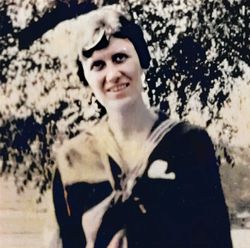
Lillian Preston Campbell Berry Buell, undated photo from Find-a-Grave. The sailor collar shirt suggests the 1920s.
The Judge’s voice echoed in Lillian’s head as she sat with an attorney and drew up a remarkable and curious will. It began with the conventional stipulation that any debts incurred by her “latest illness and death” be paid promptly, but she declined to name an executor, directing the courts to appoint “a bank or trust company” in that role. Here, we see she was her father’s daughter—she wanted to provide for her daughters, but didn’t entirely trust them to be prudent. First, she wanted $2,500 held in trust for her grandson, David Oberjat, Lillian Eloise’s son, who had a “heart ailment” and needed special medical care. She insisted the bequest for David “have preference over all other requests” and set numerous restrictions on how much would be paid monthly to her daughter, Lillian, for David’s care and how to redistribute his inheritance eventually. She made provisions for $1,000 to be held for Lillian Eloise’s personal use, and $1,000 for granddaughter Judith Oberjat, these funds also to be doled out by the trustee monthly. She directed the trustee to hold $2,000 for Elizabeth, too, paid out in installments. Most interesting, she had the trustee hold the same amount, $2,000, for Perry Buell, who she had recently married. Daughters Mary and Virginia each received $500 paid to them directly in one lump sum. Once her debts were paid and these itemized bequests were made, she wanted the rest of her estate liquidated and divided among her heirs equally. It is an extraordinary document in the way it reveals her thoughtful planning, her financial and legal savvy, and, most of all, her love and responsibility. She signed it before witnesses on August 9, 1941, then left Milwaukee on a trip to California.
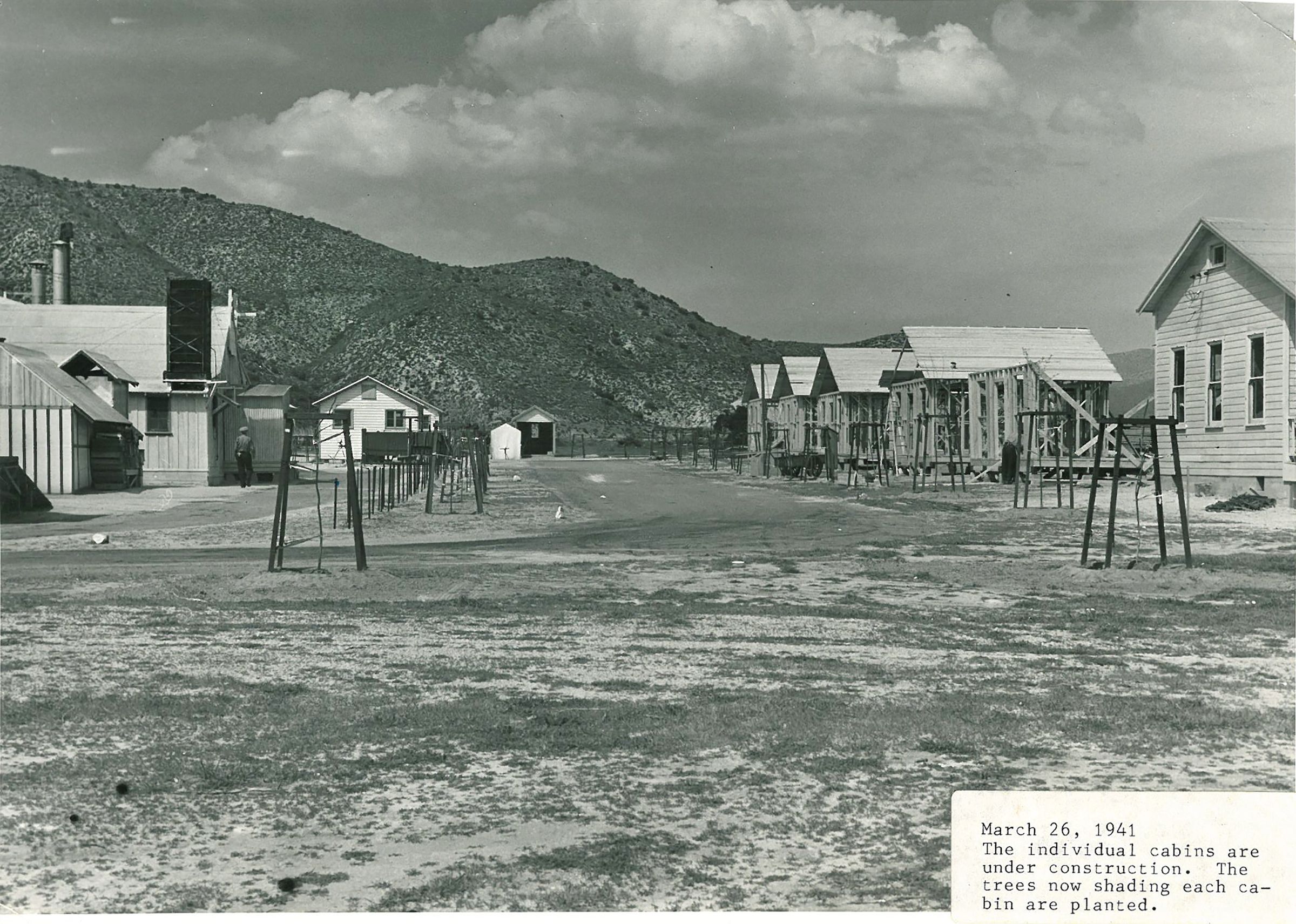
Lillian died somewhere outside Los Angeles eleven days later on August 22. I can’t find the death certificate yet, but evidence suggests she died at a tuberculosis sanitorium where she went seeking treatment in southern California’s dry, warm climate. Los Angeles was well-known for the “sanitorium belt” of facilities that surrounded the city, and I’m hopeful that more research will reveal exactly where she sought treatment and where she was buried. Back in Wisconsin, the probate court judge appointed a trustee just as she wanted. The estate records indicate she had inherited one-fifth of a West Virginia coal mine, which was liquidated per her instructions to generate $8,500 for her heirs. Lillian Eloise Berry Oberjat evidently followed Lillian Berry Buell to Los Angeles; Lillian Oberjat had divorced her husband in 1940 and was living in Santa Clara outside San Francisco in 1943, when she remarried and where four-year old David died in 1944. Perry Buell also went to Los Angeles, likely when Lillian went in August 1941. In the 1950 census, he was a “patient” at the Soledad Camp, a former Civilian Conservation Corps camp near Acton that Los Angeles County converted into a TB sanitarium in April 1940. Buell must also have been very sick when the couple married. Lillian’s bequest for her new husband, then, provided for his care at the sanitorium after her death. In fact, it seems the entire family relocated to Los Angeles to be with Lillian. Families often did that, living near the sanitorium and hoping for a recovery that rarely came.
The Soledad sanitarium located in Los Angeles County, near Acton, as new patient cabins were under construction in March 1941.
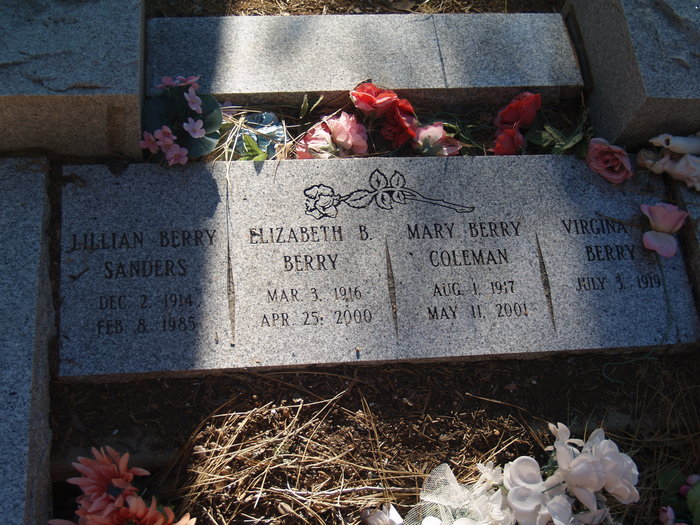
Lillian’s daughters stayed in close contact in California. Elizabeth never married, but Lillian Eloise, Mary, and Virginia all did—and all divorced. The four Berry sisters have a common plot and a common headstone outside Warren, in the mountains just north of Chico. I think that would have made their mother very happy. Despite whatever attacks on her character she experienced, her true character, her commitment to love and family carried on.
Gravestone for the four Berry sisters. From Find-a-Grave entry for Lillian Berry Sanders.
NOTES
“Normal School Student Elopes,” RTD, Feb. 15, 1913; “Faculty Expels Girl who Eloped,” RTD Feb. 17, 1913; on the Campbell family and Berry family, see federal census schedules, death records, and wills available via Ancestry.com. When Tom’s father James M. Berry died in 1909, Tom was 18. Bedford County probate records indicate he was appointed a legal guardian, attorney Hunter Miller, who paid Tom’s expenses from Tom’s share of the Berry estate. Monthly payments appear in 1910 for “board and expenses,” indicating Tom likely attended school somewhere that year, but census records state he did not attend college, only high school. I could not find him in the 1910 census, although I did find all of his siblings. ↩︎
Psalms 144: 12 says, “That our sons be as plants grown up in their youth; that our daughters be as corner stones, polished after the similitude of a palace.” Scholarly commentaries related to this passage note that ancient architecture often incorporated carved, female figures, such as caryatides in Greece or decorative, wooden cornerposts in Syria and Palestine. The mission statement, which lasted until 1951, thus had a specific scriptural and spiritual significance that students, faculty, and community members would have understood separately from the secular meaning of a ‘cornerstone’ as the first stone laid in a structure. The overt evangelical Christian culture that defined this institution is not formally acknowledged in the official campus history narrative. ↩︎
Eloise—sometimes spelled Ellaoise—went to live with her older half-sister, Mrs. Abigail Hules, after her father’s death. The School Ma’am, 1911-12 indicates she was a junior, meaning Eloise was in the 3rd year of the regular teacher training track. Probate records for her father’s estate indicate regular payments for Eloise’s “expenses at school” in 1911 and 1912 from her share of the estate. ↩︎
“February 14, 1913,” Faculty Minutes, 1909-1915, provides important details about the meeting, though not the actual deliberations. The event was eventually acknowledged in Dingledine, 80. ↩︎
See “February 14, 1913,” Faculty Minutes, 1909-1915 as well as later entries. Both Berry and Craig appealed their punishments. The faculty informed Berry (who had help from her lawyer guardian, Hunter Miller) that, since she had completed the two-year track, she was granted a certificate that enabled her to teach. They advised her to complete her student teaching assignment as she had already been assigned in 1914, then re-apply for admission to finish the next two years. Craig’s appeal dragged out into 1914, but the faculty refused to budge. ↩︎
“Faculty Expels Girl who Eloped,” RTD Feb 17, 1913. ↩︎
See federal census schedules for 1920, Ancestry.com. ↩︎