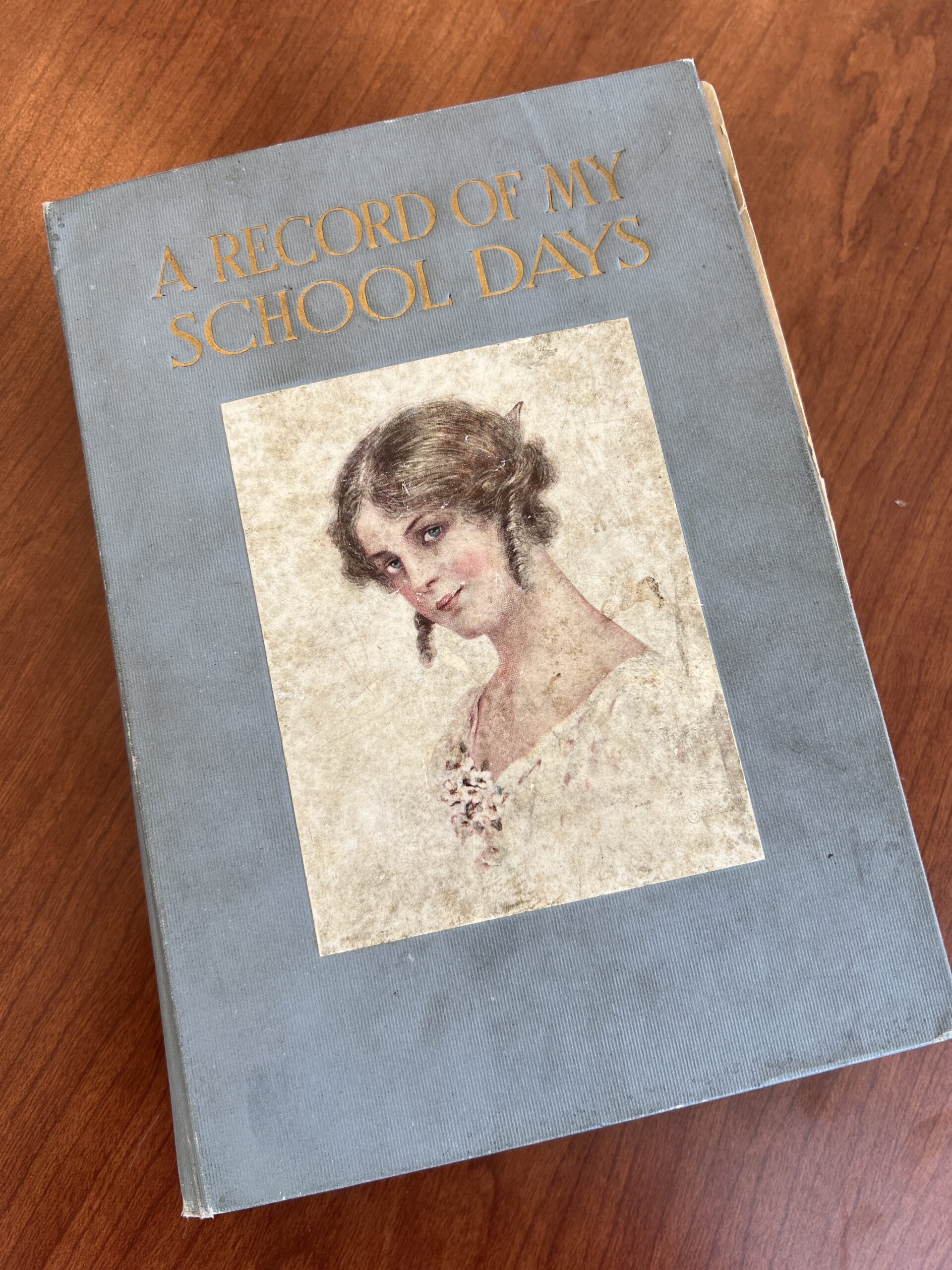
Concerns about undergraduate student ‘belongingness’ are everywhere in higher education these days, but they certainly aren’t new. College staff and faculty have always worried about students’ adjustment to campus life. This one, when it was the State Normal and Industrial School for Women, required every girl who enrolled to join two organizations to combat feelings of isolation and homesickness: the YMCA and the Athletic Association. The administration closely monitored the young women who came here and developed other interventions as well. One young woman, Velna Pearl Barker, documented her struggle with “the blues” in her 1924-1926 college scrapbook, which her daughter and granddaughter carefully preserved. Velna’s story not only helps us understand an understudied aspect of Southern women’s collegiate life then, but now.
Barker’s danville (VA) high school yearbook photo. The cardinal, 1924.
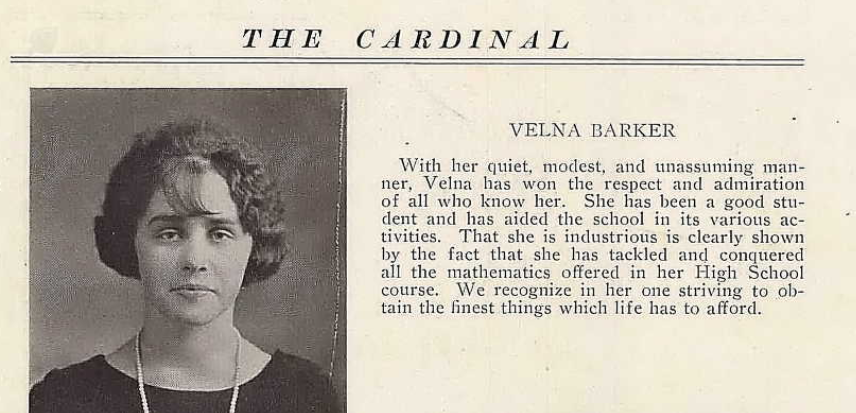
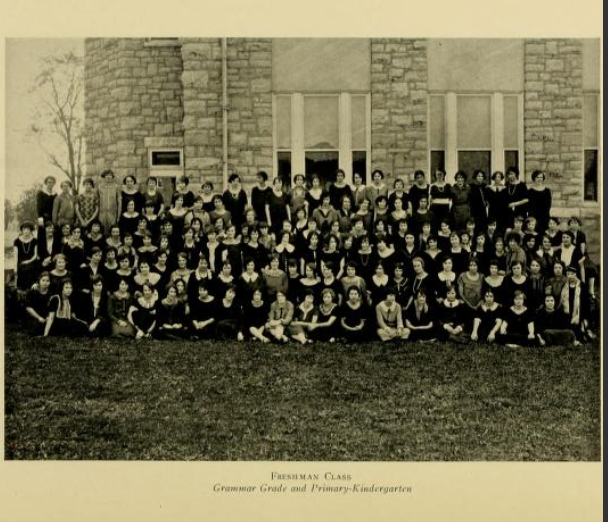
Velna Barker arrived at the Harrisonburg Teacher’s College (HTC) on Tuesday, September 23, 1924, at 9:30am. She was just 16. Her granddaughter, Carol Anderson (a 1986 JMU alumna), remembers Velna as a quiet, introverted person even in her eighties, so we can imagine Velna’s initial feelings of anxiety upon meeting the crowds on campus. That year, The Breeze reported record enrollment—over 600 students total of which roughly 50% were freshmen like Velna, away from home for the very first time. The demand for higher education among young women had risen since WWI, and Velna found herself assigned to a quadruple—you read that right, four students in one room! Her first days were a blur of activity: a mandatory “First Meeting of Class First Year” in the auditorium, an opening reception at the President’s house for new students, classes scheduled around mandatory mealtimes, and endless get-acquainted conversations with strangers.1
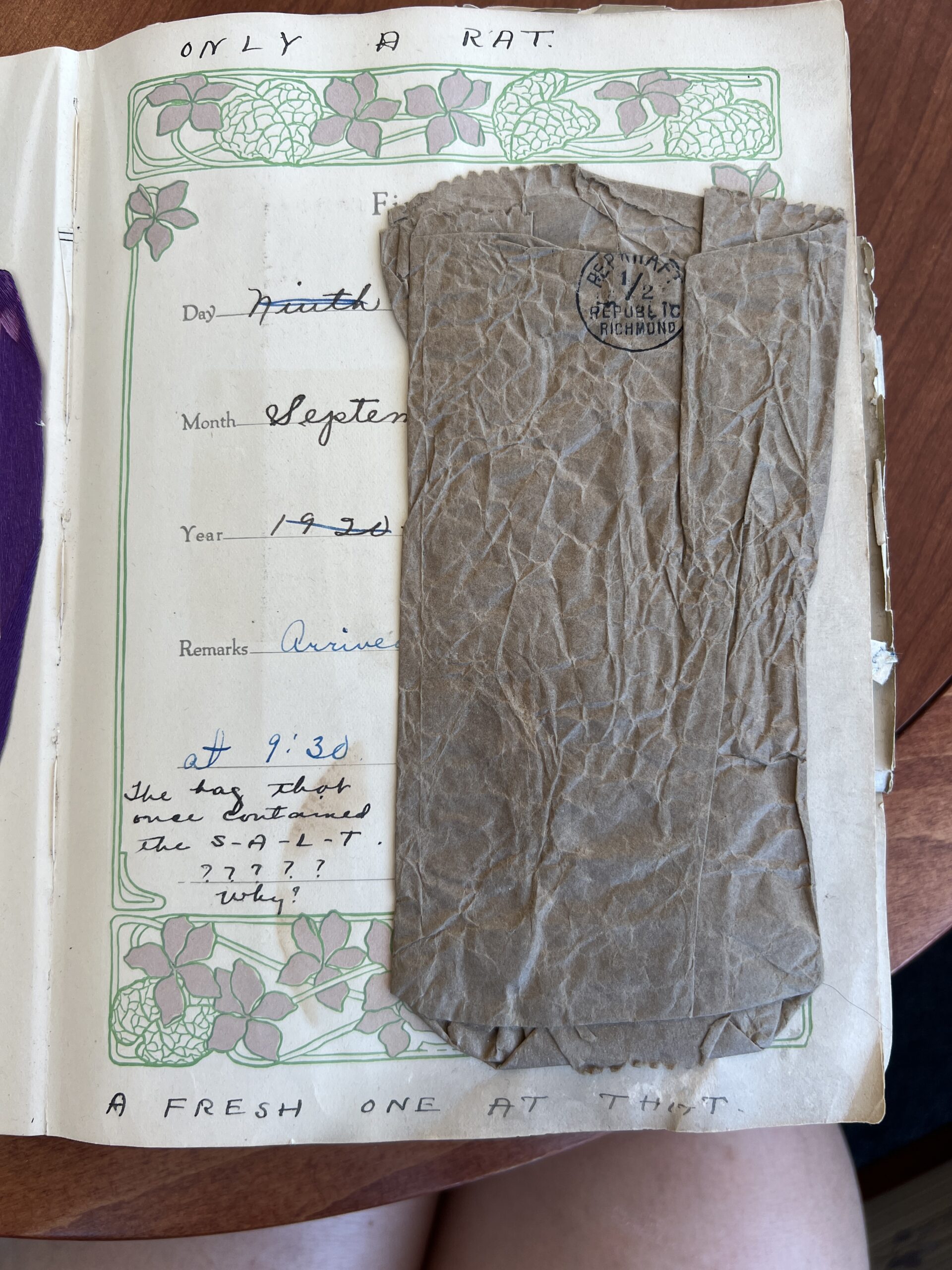
Velna had the same normal feelings of anxiety that modern students have: “Will I do well in my classes? Will I make friends? Will I get along with my roommates?” Among the first items preserved in her scrapbook are articles from The Breeze about the school’s orientation process—even then, all the mandatory meetings were leavened with a lot of planned social time to ease acculturation. The events were highly gendered, however. The entire senior class, called the “Old Girls,” bonded with the freshmen or “New Girls” in the Old Girl-New Girl wedding, a distinctive ceremony with a “bride” and “groom.” Each “Old Girl” got paired with an “New Girl,” to whom she served as a kind of mentor or coach. There was an eagerly-awaited evening when all of the Old Girls went from dorm to dorm calling formally on all of the New Girls, and a much-feared, impromptu “Stunt Night,” when randomly picked New Girls had to perform their “talents” in front of the entire student body. “The mere mention [of Stunt Night] makes every New Girl tremble,” reported The Breeze. Velna used two pages to record two days of intentionally mocking activities. All freshmen “rats” had to wear their hair plaited “down the back” if long or “combed back behind their ears” if bobbed. They had to hold doors open for seniors, answer all seniors’ questions with “yes, ma’am” or “no, ma’am,” and walk behind seniors at all times. Most important, each freshman had to wear suspended around her neck a small, brown paper bag filled with salt; whenever anyone asked “why she wears it, she must reply, Because I am so fresh.”2 Compared to contemporary hazing rituals, these behaviors seem harmless, even quaint, but they served the same purpose, and we cannot know what shy students like Velna actually felt or what seniors did to the rats when witnesses were not around.
Sometime in these early weeks, Velna began to feel homesick. Internal evidence in the scrapbook indicates she compiled it at a later point, but intentionally included items indicative of her early unhappiness. Her handwritten annotations or captions for the items reinforces this interpretation. One article, entitled “Oh I am so Blue,” commented on the frequency of the “blues” on campus. Above the title, Velna wrote, “DAILY EXPRESSION.” The article suggested a common antidote: “[D]evelop your initiative. Keep busy, when you have done the things assigned to you, be a wide-awake explorer and discover the myriad of other interesting things to be done.” Next to it, she pasted a similar item titled “Coming Back,” which acknowledged that some students were reluctant to return to campus after a visit home. Velna added, “How true it is.”
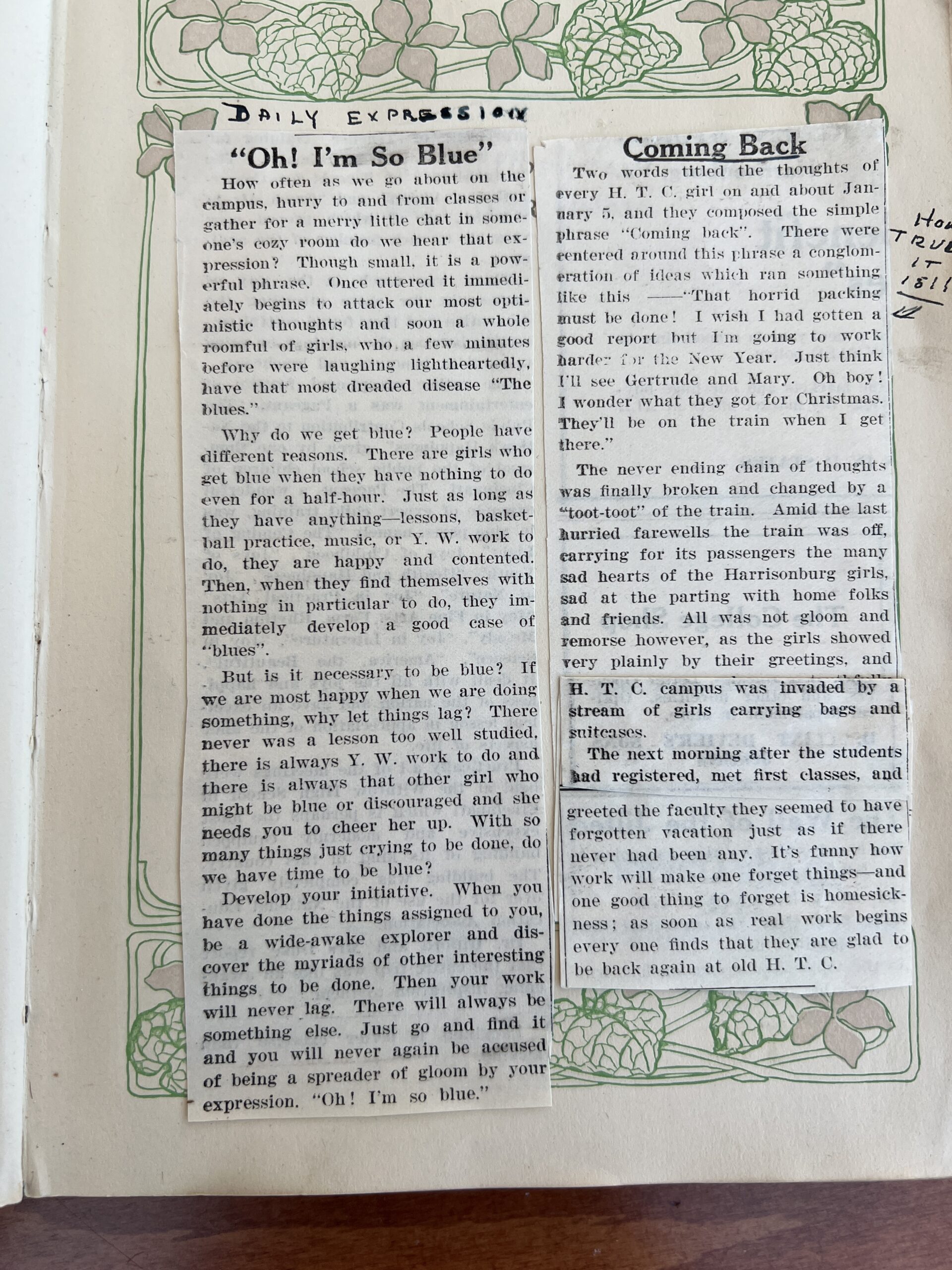
Velna saved these particular items because homesickness was a defining part of her experience, and yet she knew she was not unusual in this regard. Every fall, in fact, starting with the first issue in 1922, The Breeze ran poems, jokes, editorials, and articles reflecting the common theme of homesickness and its antidotes. All of the paper’s content came from the students themselves. Velna must have taken note of a poem published by her classmate, Hortense Eanes, another young woman from Danville on October 25, 1924. Titled “Advice,” it said:
When you’re feelin’ sorta blue
And the world is going wrong
And the hardest thing to do
Is to sing a little song
Just think of all the things
You’re going to say
When you see a chance to help
A fellow on his way.
The second stanza, as the first hints, advises the homesick girl to seek out and befriend another lonely student. Being “occupied with thoughts of good,” Eanes concludes, “You’ll forget your mood.”3
Making new friends certainly did help. Velna recorded the names of her first three roommates, Louise Kent, Virginia Bowles, and Alice Schofield, but her closest confidants were two other “rats”, Dot (Dorothy) Ridings and Edna Holland. Her scrapbook shows that Velna went to movies at the New Virginia Theater on Main Street, dances in the gymnasium in the basement of Ashby Hall (now Harper Allen-Lee Hall), and gatherings in friends’ dorm rooms, so we know she had a conventional social life and she often underlined the names of specific friends in the items she saved. Much of her time, however, focused on her studies. Velna pursued the two-year course leading to a professional diploma enabling her to teach grammar school. Her first quarter schedule, carefully saved, shows classes in Music, Hygiene, English, Education, Psychology and Geography. At the end of the first 12 week quarter, she had 2 Cs, 4 Bs, and 2 As.
Velna took the train back to Danville between quarters but mostly relied on the US postal service to maintain ties to home. The Barkers were a wage-earning family. Census records show her father, W. Onico Barker, worked for the Danville City Fire Department while she was a child, then became superintendent of the city cemeteries. Her mother, Lula Covington Barker, managed a household of six children, all born between 1903 and 1916. Velna, the third child, was the only girl and the apple of her mother’s eye. It was hard for them to be apart, that much is obvious from the scrapbook. Velna preserved whole letters, plus cut out, canceled postage stamps and snippets of brown wrapping paper from care packages from Lula. One snippet she annotated “Box from my mother” and another, “Thanksgiving box from Ernest and Vivian.”
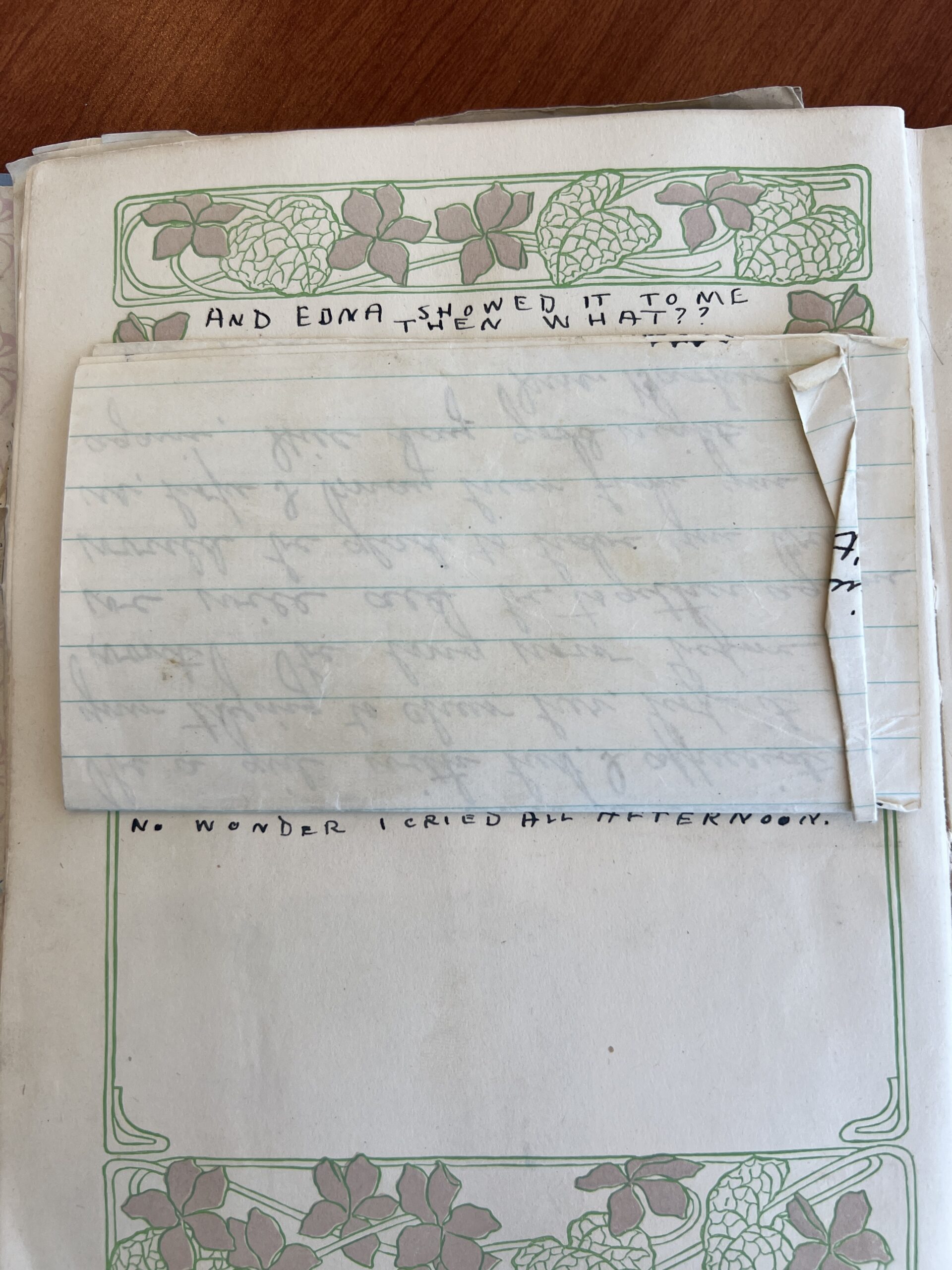
The scrapbook contains a particularly poignant item that conveys her sense of separation. It is a letter from Lula Barker to Velna’s good friend, Edna. Velna must have shared with her mother how Edna had helped her feel better, and so Lula Barker took it upon herself to send Edna a personal note acknowledging the situation. Addressing her as “Dearest Edna,” she wrote, “I appreciate your trying to cheer her [Velna].” Even though she loved her boys, Lula admitted, “[Velna] is my life, my all,” and she expressed her hope to thank Edna someday in person. Edna gave the letter to Velna, who reacted strongly. Note Velna’s own memory of the event: around the pasted in letter, she added: “And Edna showed it to me. Then what?? No wonder I cried all afternoon.”
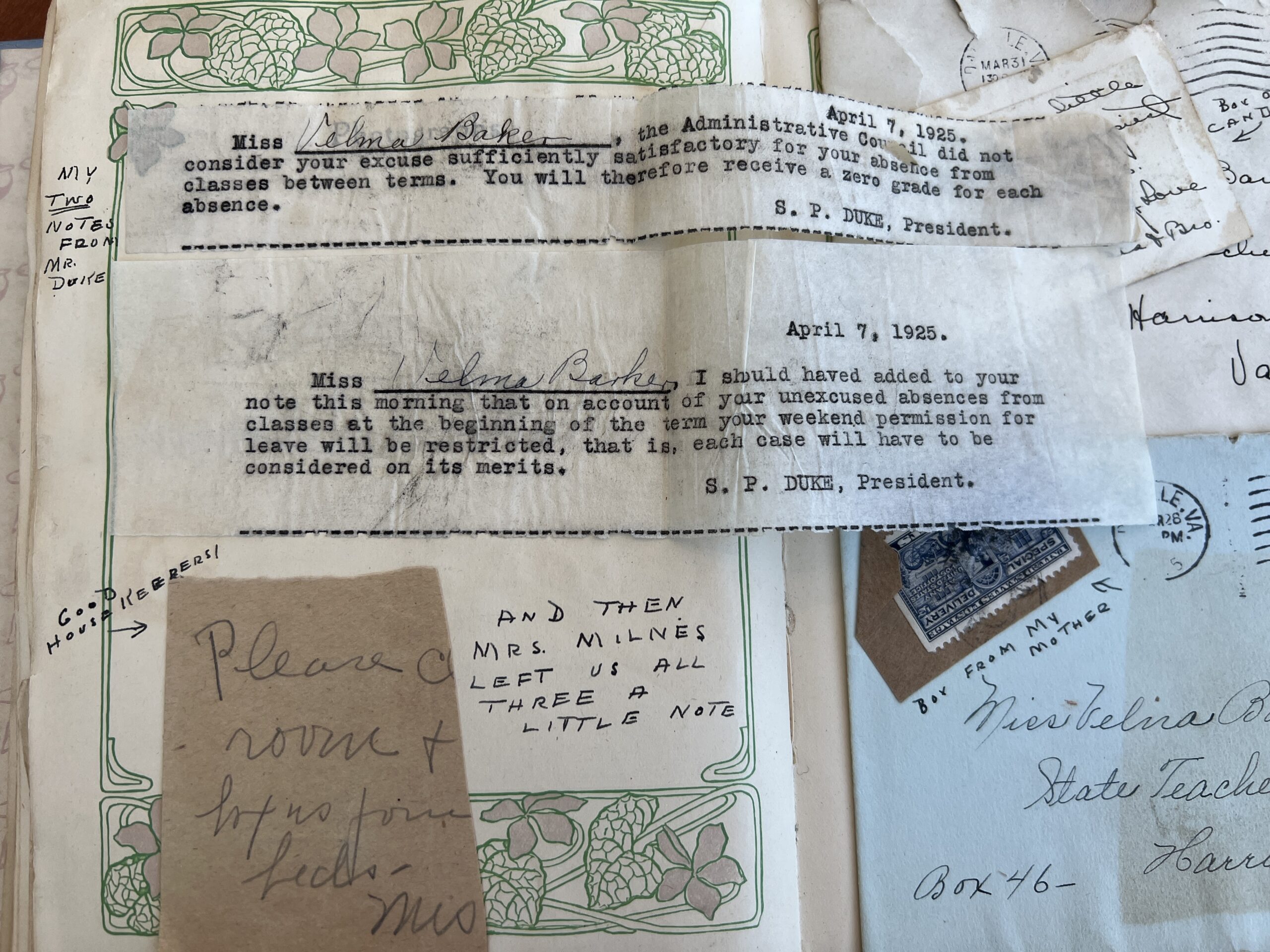
Spring quarter 1925 was apparently difficult. Velna was among the many students who, The Breeze reported, went home over the Easter holidays, but once back in Danville, she did not want to return. In fact, she returned to campus so late that she faced formal disciplinary proceedings. On April 7, 1925, President Duke sent her two official notices. The first indicated that the Administrative Council “did not consider your excuse satisfactory” and decided to give her a zero for each day absent. The second, sent a few hours later, announced a further penalty that permission to leave campus in the future would be restricted. A few weeks after that, she also received a deficiency note from Duke indicating her professor had reported her “falling behind” in ED 116. Duke urged her to seek help if needed. Here, we see evidence that a student’s emotional state negatively affected academic performance even then, just as it does today. We also see proof that Velna had what we call ‘resilience.’ Instead of being ashamed and destroying these items, she saved them and add an arch comment in the margin: “My two notes from Mr. Duke.”
Velna’s second year obviously proceeded better than the first. The scrapbook shows her interest in young men, for example, and theirs in her. She received gift boxes of chocolates, which she documented by keeping labels, and calling cards from potential beaux named “S. Talmadge Magann” (called “Tally”), “Don Key,” and several men known only by their first names, Lester and Roy. A letter from her friend Dot Ridings teasingly refers to “Roy” as Velna’s love interest at the time, while expressing Dot’s own hope to marry someone named “Charles.” That might be “Mr. C. M. Jennings,” a cadet from VMI, who performed at HTC with the VMI minstrel show and whose name Velna underlined in the show program. The young women of HTC had many opportunities to meet young men, in fact, including athletic events and dances. According to The Breeze, which ran a regular column announcing visitors to campus, especially men, Velna received calls from George Carpenter from Hampton in May 1925 and Louis Ballou from UVa in fall 1925. Gentlemen callers had to be approved by a student’s parents, so we can be sure the Barkers considered dating a helpful distraction.
As a sophomore, Velna also became more active in several student organizations. In 1924, she joined the Alpha Literary Society and served as an officer in one of the Alpha subgroups. In a previous post, I explained the origins and function of the Lee and Lanier societies. Established in 1909, they were invitation-only organizations, functioning similarly to sororities among the students enrolled in four-year degree programs. Due to rising enrollments, Duke’s administration created a third literary society named for Thomas Nelson Page, then, in Velna’s freshman year, a fourth society called Alpha. Alpha was intentionally inclusive–every new girl belonged, including those like Velna on two-year and special tracks. Once a girl had proven herself by performing satisfactorily in Alpha for a full quarter, she was eligible to be invited to join one of the three selective societies. Typically, the women selected to advance were outgoing sorts, comfortable with public speaking and performances. Velna, of course, disliked being the center of attention and stayed where she was. She joined the Choral Club, however, and continued to attend athletic events and theatrical performances with her friends.
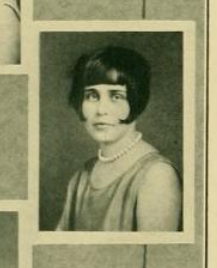
Velna overcame her “blues” and successfully completed her diploma in December 1926. In her time at HTC, she came to feel a sense of attachment to her alma mater and recognized through the very act of making a scrapbook and curating her memories that the college experience was crucial to her personal development. It’s not clear when exactly Velna make her scrapbook, but she seems to have done so with the benefit of time and distance, possibly after graduation. As I’ve written previously, college scrapbooks were popular in the early 20thC precisely because they allowed young women an opportunity to express themselves at a crucial time of transition and growth. Perhaps Velna made hers while home on break or even after she became a teacher, when she could better appreciate her own transformation. In 1931, she married Percy Scearce and started a family in Danville. Although she shared some stories of her time at HTC with her descendants, she kept the scrapbook and her personal journey to herself.
After Velna passed away in 1998, her daughter and other family members saved the scrapbook and some yearbooks among other special papers in a keepsake box. A few years later, they pulled the box out and realized what a treasure Velna had left them. As Carol recalled:
“We enjoyed reading the scrapbook because it revealed a side of Grandma we didn’t know. Even my mother commented on this. My grandma . . . always made sure to present herself as a poised, young Southern woman. Even as close family, this is the person we saw—someone very poised, private, reserved, and well-mannered, always ‘put together’ and never showing any struggles. I remember my mom even said, ‘I never could have imagined my mother being scolded for anything,’ when we saw the notes about the absences from Mr. Duke. And, of course, it was interesting to see how grandma spoke about her friends, dating, and special activities.”
Although her time as a student at this institution helped Velna Barker Scearce become the poised and polished adult her family recalled, that quiet, homesick girl never entirely disappeared. Keeping the scrapbook was a way for her to give grace to that special, teenaged self and make meaning of her journey from adolescence to young adulthood. For us in the present, Velna’s record of her school days is a powerful reminder that college students have always had to make adjustments. With a supportive family, new friends, and caring faculty and staff, they usually find their way to success.
With deep thanks to Carol Anderson (’86), who shared her grandmother’s scrapbook with me and read an early draft of this essay.