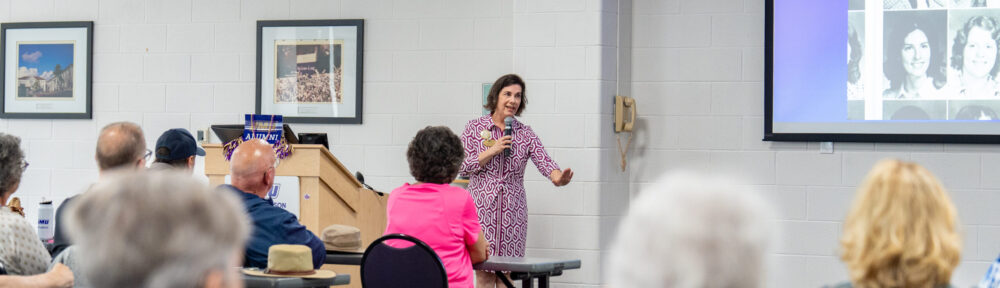
Is it Dingle-DEEN or Dingle-DINE? You’d better get it right because it’s spoken a lot on campus. There’s a Dingledine Hall, multiple Dingledine scholarships, and an oil portrait among other named things. At some point, the marketing and branding folks started to refer to the Dingledine family as “JMU royalty,” playing off the “dukes” theme. That is because three Dingledines had significant impact on this institution. They are: Raymond C. Dingledine, Sr., faculty member from 1914 until 1941; his wife, Agness Stribling Dingledine, an alumna who taught here briefly and then became staff later; and their son, Raymond Jr., who joined the faculty in 1948 and was head of the Department of History. In these two posts, I offer a fresh analysis of these important figures based on new research and with an eye for accuracy. Read on for more!
Raymond C. Dingledine Sr. (1892-1941)
Let’s start with Raymond Dingledine Sr., who mostly grew up right here in Harrisonburg, the eldest child of William J. Dingledine and his wife, Ella. His father, William, a banker, moved the family from Albany, New York, in 1900, when he accepted a position at the newly established Rockingham National Bank on Court Square. William Dingledine grew up in Shenandoah County, so the new job effectively brought him back home to the Valley. He and Ella acquired a large, Queen Anne style house on the SW corner of Grace Street and S. Main Street, currently the site of Anthony-Seeger Hall. It was a conspicuous location. At the time, only a few houses existed along the southern end of Main Street, which was still an unpaved road—the old Valley Turnpike that traversed the entire Shenandoah Valley from Winchester to Roanoke. As a child, Raymond Sr. could stand on the front porch and view the Sprinkle family’s home across the road, and, next to that, a large, rocky cow pasture belonging to the Newman family’s dairy farm. That pasture eventually became Ray’s workplace, the state Normal school’s campus.
Ray grew up in an affluent, socially prominent family. As head cashier, William Dingledine was the bank manager, second only to the president, A. W. Newman. William was also a deacon at the prestigious First Presbyterian Church on Court Square. The Dingledines were welcomed eagerly into the community. Another son, William Jr., and a daughter, Gladys, were born after their move to Harrisonburg. By 1910, however, the household also included Ray’s maternal grandmother and aunt. That year, the census documents the presence of a live-in Black cook, 21 year-old Virginia Washington, whose occupation points to the regular employment of Black help over the years. White families like the Dingledines also relied on the services of Black laundresses, cleaning people, and gardeners.1
Ray Dingledine became acculturated to the culture of Jim Crow as he grew to manhood. Lessons were everywhere. He attended the local school on Main Street (now part of City Hall), which had Black custodians, and he visited his father’s bank, which employed Black janitors and errand boys. Bright and ambitious, he imagined for himself a social position like his father had and he followed with interest as Harrisonburg’s leading men lobbied the legislature in 1908 to host the proposed women’s school. In fact, the first surprise is that William Dingledine helped bring the Normal to Harrisonburg.
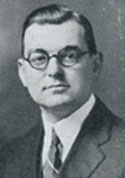
Ray understood that educational opportunities in Virginia varied greatly by race, gender, and class. As the first buildings for “the Normal School” rose on the Newman farm in summer 1909, he took his place at UVa, one of the state’s leading institutions for white men. Then as now, a young man’s choice reflected his intended career path and his presumptive status in the social hierarchy. The same forces that created the Normal school for middle class women were opening higher education to more middle class men, and UVa’s academic programs were changing and expanding under President Edwin Alderman. Ray could have chosen commerce, for example, or forestry or one of several other new professional programs. Instead, he studied Physics, a traditional and serious liberal arts degree subject. However, he also participated actively in student life. As an editor of Corks and Curls, for example, he helped decide what the yearbook content would be. JMU professor Stephen Poulson’s book, Racism on Campus: A Visual History of Prominent Virginia Colleges and Howard University (2021), analyzes early 20thC yearbooks to reveal institutional norms for student culture across multiple universities, including both UVa and here. It provides useful insights into Dingledine’s experiences at that time.
Ray graduated in spring 1914, and with his bachelors degree in Physics, he was sufficiently qualified to teach math and science, so President Burruss hired him for the summer session at the Normal school. The young women could only complete two year certificates at that time, and quite a few were still completing high school diplomas in a preparatory track. The campus was booming, such was the demand for female education. Burruss may have held out to Ray the promise of a full-time position someday in the future, but Ray had already decided to return to UVa for a masters degree. Then, in September, William Dingledine died unexpectedly, leaving 22-year-old Ray with a big responsibility to support his mother and younger siblings. The death certificate cited complications of “a nervous breakdown,” which suggests that William had been unwell for some time. As soon as Ray finished his masters coursework in spring 1915, he became a full-time member of the faculty, a decision with momentous consequences. [See Fac minutes]
Agness Brown Stribling Dingledine (1894-1974)
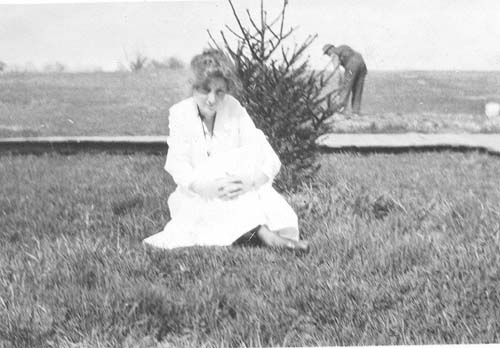
In the early fall of 1915, Ray met another new instructor, Agness Brown Stribling, the woman who would become his wife. Agness had only recently graduated from the Normal herself. According to their daughter, Jane Dingledine Hueston, Burruss hired Agness because he needed someone to teach English classes while one of the full-time instructors was away on sabbatical.2 Burruss clearly knew Agness well. Born in Berryville, VA, in November 1894, the daughter of a Presbyterian minister, she had grown up in the Tidewater region and returned to the Valley to enroll at the Normal in September 1913. Like all young women there, she belonged to the YWCA, but she became president by 1915. The School Ma’am indicates she served as secretary of the Lee Literary Society, president of the Student Association, and chair of the Honor Committee. But it was her academic excellence that drew Burruss’s attention. A quote in the School Ma’am indicates she was known for both her intellect and her leadership ability.3
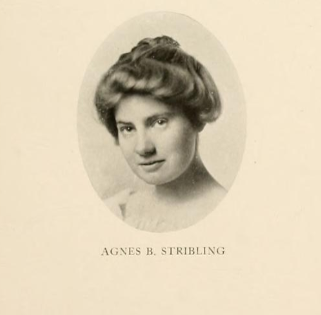
Jane noted that her mother, Agness, was the “youngest member of the faculty,” a point of great family pride, since she was only 21 when Burruss hired her. She was not much older than her students, in other words, though undoubtedly poised and mature. Too young to be a dorm matron, she may have lived on campus in the former Newman farmhouse, where several other single women faculty lived, or she may have rented a room in town. Either way, she spent most of her time in Science Hall, now called Gabbin Hall. The English classroom occupied the southeast corner on the main floor, just opposite the library. Formal faculty meetings took place upstairs, but she had opportunities to confer with her former teachers, especially Dr. Wayland and Miss Cleveland, in the common dining room, in the hallways, and after student assemblies. Pleased with her work that fall 1915 quarter, Burruss hired her back for the next one and for spring 1916, when he hired her full time for the next academic year. The 1916-1917 School Ma’am lists her as a member of the regular faculty teaching English and Education. And right below her name is that of Raymond C. Dingledine, instructor of Mathematics.4
Part of the Dingledine mystique is that they fell in love while working together on campus. Daughter Jane recalled that, because her parents were “the two youngest faculty,” they had to go meet new students at the train station and escort them to campus.5 She implies that this activity—not faculty meetings–is how they actually became acquainted, so it’s worth considering what they were doing. In effect, they had to stand outside on the passenger platform for hours, waiting for the various trains to come in each day. As the young women arrived, often dozens at a time, there was a great hullabaloo as Black and white men loaded their trunks and cases onto wagons sent by the school. Agness and Ray and any other faculty present welcomed the new students and gave them directions to the campus, which could be reached by foot or by carriage or later, by a jitney bus. Between the trains, they had lots of time to talk. In the 1910s, Victorian courtship rituals had not yet evolved into the freer, unstructured norms of modern “dating,” and a couple like Ray and Agness would have been closely observed by the other faculty. They no doubt took advantage of other opportunities to interact privately, too, perhaps occasional walks around the campus or into town. By fall 1917 they were engaged.
The US had entered World War I by this point. Ray had registered for the draft in June 1917. In addition to listing himself as “teacher, Normal School,” he wrote “manager, farm,” and said he was “needed at home,” no doubt a reference to his status as breadwinner and head of the household. Ray’s mother, Ella Dingledine, and his younger siblings, William and Gladys, still lived there, and so did Ray’s elderly grandmother and aunt. The draft card also noted his “bad eyes,” which had required him to wear glasses since youth. On campus and in the community, he became involved in local war efforts. There were war bond campaigns, for example, bandage rolling drives, and even civilian drills for women students on Maypole Hill. Men from around the county came into Harrisonburg to get the train that took them away for boot camp. Ray was never called to serve, however.
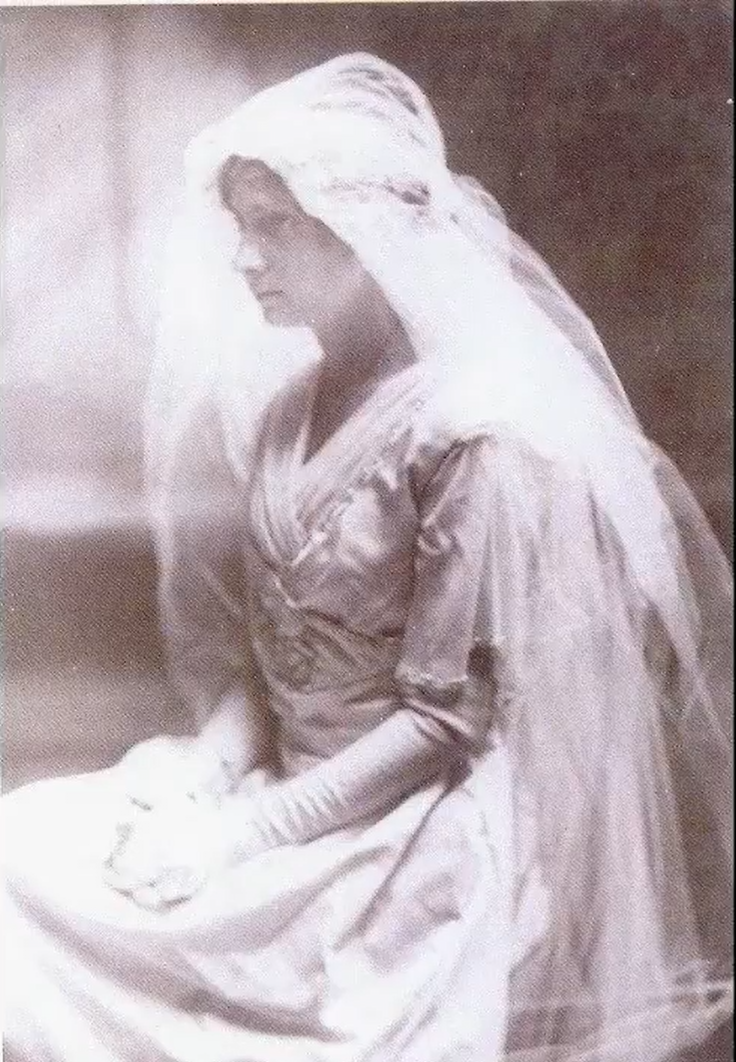
After a lovely winter wedding on Feb. 21, 1918, at the Petersburg church where Agness’s father was then minister, the newlyweds settled into the Dingledine family home on S. Main Street. Ray continued to offer courses in math and science, but since married women were prohibited by law from working, Agness stopped teaching and by late spring, she was pregnant. That summer, the Spanish Flu pandemic broke out in Virginia, beginning among the soldiers at Fort Lee (now Fort Walker). Unbeknownst to all, the young women who disembarked at the C&W train station for the fall quarter brought the disease to campus. The first Normal student went to the infirmary on Sept. 28, just three days after the opening meeting. Burruss fell so ill he ceded control of the Normal temporarily to Prof. James Johnston. Then, on Oct. 6, Burruss ordered the school closed. The local paper reported that “one half the students and more than one-half of the instructors” were sick. Young adults and pregnant women were especially susceptible to this strain, though no one knew why. The Dingledines must have been relieved when cold weather arrived in November, and the flu subsided. Agness’s baby, a boy, arrived on January 15, 1919, healthy and strong. They named him Raymond Carlyle Dingledine, Jr.
An early power couple
In the 1920s, the Dingledines actively involved themselves in campus life as new post-war vocational opportunities opened for single women and enrollments soared. Like other married faculty couples, they annually sponsored an entire class of students (roughly 300 students per freshman class)6 and came to know many of them quite well by graduation day. Ray continued to teach, however, he switched inexplicably from mathematics to US and Virginia History. Agness managed their growing, multigenerational household. Jane was born in 1921, then William arrived in 1926 and Agness in 1929. Jane recalled vividly what it was like to be the child of faculty at the renamed State Teacher’s College. Apparently, the four Dingledine children frequently attended events on campus, which meant that Ray and Agness did, too. More telling, Jane recalled the large picnic suppers that Agness hosted annually for their sponsored class in the family’s yard. Crowds of students enjoyed “fried chicken and strawberry shortcake.”7 We can imagine the tables set up outside, the pitchers of lemonade, and the platters of food prepared and served by the help that Agness supervised, including “domestic” Fannie Yankey, a 24 year old, white woman, who lived at the house full time.8 Jane also recalled more intimate dinners, when Agness invited homesick students to join the family for a meal. The Dingledines participated in freshmen orientation and attended all formal events, like receptions. Agness even became an officer in the Alumnae Association in this period and welcomed students on the association’s behalf. [need Breeze cite]
Following President Duke’s personal advice and example (he led the Chamber of Commerce for a time), faculty at the State Teacher’s College became more active in Harrisonburg’s civic life, and the Dingledines led the way. As a ‘townie,’ Ray became active in city government. Elected to city council in 1928, he served until 1936.9 Like his father, he was active in First Presbyterian Church, but so was Agness, who taught Sunday school and volunteered. During the Great Depression, Ray Dingledine and the other city fathers worked with Duke and the board of trustees to arrange federal funds to complete the construction of Wilson Hall in 1931, but they also implemented other New Deal projects to compensate for lost jobs. Jane recalled a trip with Ray to a CCC camp in the Blue Ridge Mountains, indicating he had a role in urging development of Shenandoah National Park, which many Harrisonburg leaders favored for the potential tourist dollars it would bring.10 Speaking from her perspective as a young girl, Jane said the campus was insulated from the town. In fact, this institution’s growth has always depended on close relationships with local businessmen and politicians and vice versa.
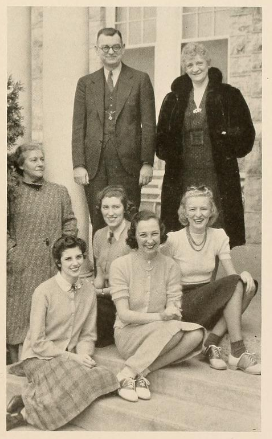
Somehow, amidst all this off-campus service—or perhaps because of it–Ray became faculty secretary in 1931. In this important role, he kept minutes for formal faculty meetings and advised Duke on faculty concerns. He effectively served as a kind of faculty senate speaker. He also served as an advisor to the Student Government, which required him to weigh on matters of academic discipline. The 1930s were difficult, for enrollments dipped due to the economic crises. Meanwhile, Agness joined the local chapter of the Daughters of the American Revolution, which hosted meetings and events, sponsored educational programs in the local schools, and offered much-needed scholarships to young women at the college, renamed Madison College in 1938. They were truly a power couple in Harrisonburg.
This pleasant world changed dramatically in February 1941, when Ray died suddenly of acute kidney disease. He was only 49.11 Agness was devastated. Ray Jr. had graduated from UVa with degrees in History and was serving as a signalman in the US Army, while William (Bill?) was away serving in the European Theater in medical corps. Jane, however, was a junior at Madison College, and young Nonie was still in grade school. Now on her own at 47, Agness needed a job. She first became a summer camp hostess at Massannetta Springs, a Presbyterian retreat center in Rockingham County. William Dingledine was a cofounder and treasurer of the center, and both Ray Sr. and Agness had been involved in its summer programs; these ties helped her find paid employment there.12 As a hostess, Agness likely lived on site when the camps were in session, and she began renting the large Dingledine house on Main Street to Madison College to make additional income.
Mrs. Dingledine
After the war, Agness developed a new relationship with her alma mater. Somehow, she leveraged her years of volunteer activity into a paid position as a hostess.13 This term referred to the mature women, usually widows, who lived in the dormitories to provide adult supervision and counsel. Agness remembered from her own schooldays the redoubtable Mrs. Brooke, then called the ‘matron’. Hostesses mediated their residents’ daily interactions in the crowded residence halls, enforced dress, decorum, and deportment, and monitored the comings and goings of the young women and their visitors. The 1950 census indicates that a dozen hostesses lived on campus. Some were full-time staff or teaching faculty at the College, like Adele Blackwell, professor of Home Economics, and the registrar Helen Frank. Sometimes, hostesses were called house mothers, though not all of them were maternal types. Only a few earned the nickname “Mama.”14 Agness’ new job was at Sprinkel House, the residence of Tri Sigma (Sigma Sigma Sigma) Sorority. Sprinkel was on the southeast corner of S. Main and Grace, right across the street from Dingledine House, then serving Zeta Tau Alpha Sorority, and next door to Carter House, occupied by Alpha Sigma Alpha. Interestingly, Agness didn’t sell Dingledine House to Madison College right away. Perhaps she hoped to live there again someday.
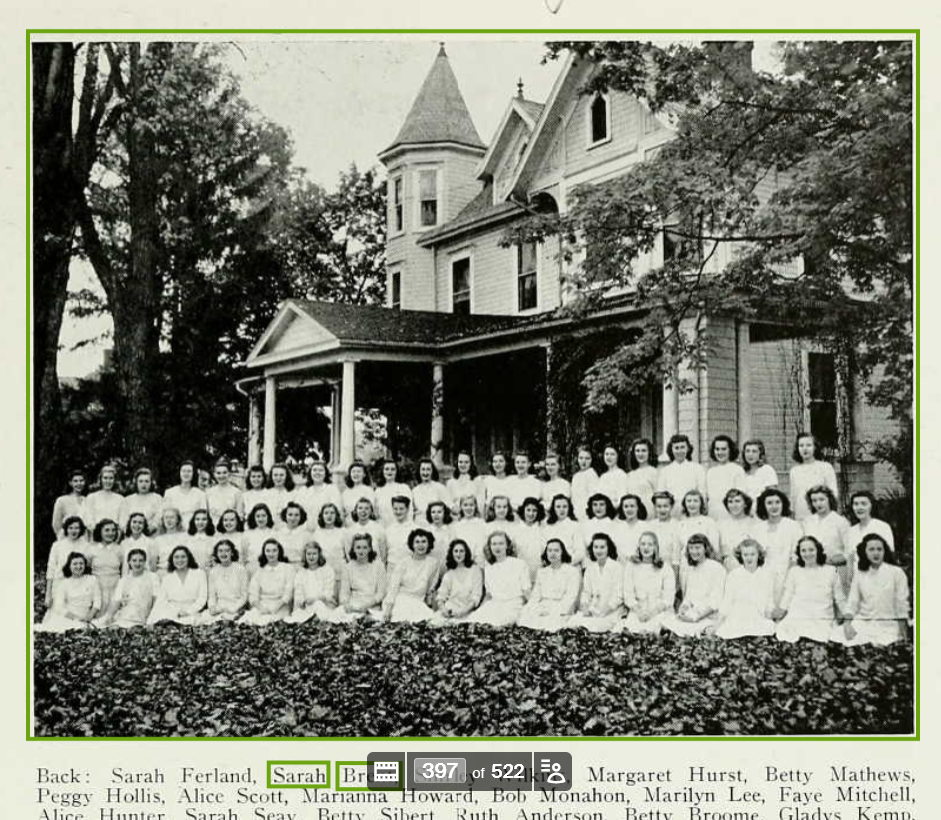
Alumnae stories about “Mama Ding” date from her time at Sprinkel House. In the 1950s, around 45-50 young women aged 18 to 21 belonged to Tri Sigma, though only a fraction lived under her watchful eye. Looking back, Caroline Wake (‘52) said: “You’d think that us girls living in Tri-Sigma House and Alpha Sigma Alpha House would have been great rivals instead of great friends, but we were all Mama Ding’s girls. . . The time we spent at Madison bonded us. And our housemother, Mama Ding, enforced the same kind of rules and morals that our parents taught us. We all became very close.” Yearbooks document the annual rush parties, which had themes like the Old West and Hawaiian luau, plus informal pajama parties, late-night bull sessions with popcorn, and every day “breakfast with Mama Ding.” As in the 1920s and 1930s, Agness clearly enjoyed her work and her relationship with “her girls.” A telling story came from Patsy Smith Wilson (’58): “Our house mother, Mama Ding had a special pair of XXXL underwear that she pulled out for panty raids. The W&L (Washington and Lee University) boys came a callin’ one night, and Mama Ding yelled down to them, ‘My girls can’t spare any of their underwear, but you can have a pair of mine.’ And she waved these huge undies out the window. The W&L boys just died.”15
Of course, Agness continued to mother her own children while she worked at Sprinkel, but they were adults. Daughter Jane graduated from Madison in 1944 and married Robert Hueston at First Presbyterian in 1949. The reception afterwards was held at Senior Hall (now Converse Hall), and they both began teaching careers in WV. Nonie graduated from Madison in 1951 with a degree in home economics, married, and moved to Fredericksburg. Agness was also a grandmother by this time. Ray and Emily lived a block away with their two children at 739 S. Mason Street, and Bill and Ann Reel (Emily’s sister) lived with their family in Charlottesville, where he was a doctor. But Agness had a life of her own. In a 1957 interview marking her 40 years service to the College, for example, she highlighted her church work as another important source of satisfaction.
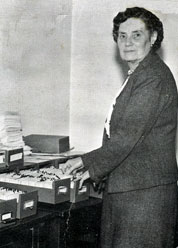
The nickname “Mama Ding,” however lovingly given, diminishes Agness’s many public contributions by masking them in domesticity. The evidence is clear that she always sought and relished her work outside the home, even outside the sorority house. When the census taker came to Sprinkel House in 1950, she gave her occupation as “dorm hostess and part-time teacher,” indicating she valued that role, likely as a Sunday School teacher. She also told the census taker that she worked 84 hours a week—an astonishing number when the other hostesses worked 70, the dean of women worked 48, the registrar, 40 and President Miller, 50! Still involved in her beloved Alumnae Association, in 1952, she became its secretary, a position she held until 1967, after she “retired” as hostess. Her duties as secretary were to keep accurate and current lists of graduates’ names and addresses, organize and support chapters, speak at chapter meetings, and plan and host the annual homecoming weekend.
Agness also remained active in the community. In May 1957, the Massanutten Chapter of the DAR elected her regent or chapter president.16 She eventually served two terms as the chapter’s chief officer, but she also held other roles during her lengthy membership. The weekly Women’s Page of the local paper is full of the chapter’s activities, which revolved around patriotic education for children, proper use of the flag, good citizenship, and conservation of historic objects and buildings. Minutes books and related records are kept at JMU’s Special Collections and would provide important new insights into her leadership of this organization. Agness also continued her beloved Sunday school classes and hosted bible study circles for women church members. In recognition of her church work, she became the first woman appointed elder at First Presbyterian.17
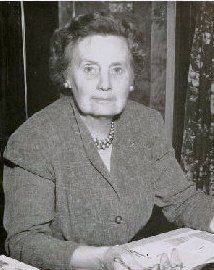
Agness finally slowed down in the late 1960s. She lived in a house with daughter Jane Heuston on Monument Avenue, having sold Dingledine House to Madison in 1953. She continued to teach Sunday School in retirement, however, and maintained other volunteer work. Her death certificate indicates she was diagnosed with breast cancer around 1968 and received treatment, but it no doubt weakened her. She lived to see Madison College name a new dormitory in the Village “Dingledine Hall” in her honor in 1969. After she passed away in November 1974, notices went out through the Alumnae Association and a glowing obituary in the Richmond Times Dispatch testified to her significant impact. Like many bright, ambitious women of her generation, Agness Dingledine navigated a patriarchal culture that limited her opportunities and defined her in terms of marriage and motherhood. Today, however, we can question that narrow ‘Mama Ding’ framing and recognize her myriad accomplishments as a distinguished alumna, counselor, community leader, educator, local historian, church elder, and administrator.
NOTES
- A search through public records indicates that Virginia Washington was the child of George and Florence Washington, a ‘mulatto’ couple who lived in nearby Bridgewater. Like all young Black women in the rural south, Virginia had few opportunities for paid work besides domestic service of some kind. The scholarship on Black domestics is grim, underscoring the long hours, low wages, demeaning treatment, and sexual harassment they regularly faced. Around the time that Raymond returned home from UVa in 1914, she joined the Great Migration north in search of a better life. Virginia Washington found work as a domestic in Washington DC, where she met and married Harry Gaines, a Black man from St. Louis, Missouri, in 1916. ↩︎
- Hueston interview 2012 ↩︎
- See School Ma’ams for 1914 and 1915. ↩︎
- See School Ma’am, 1917. ↩︎
- Hueston interview 2010. ↩︎
- See School Ma’am. ↩︎
- Hueston interview 2010. ↩︎
- 1930 federal census for Harrisonburg, VA. ↩︎
- Harrisonburg City Council webpage ↩︎
- On this point see Ehrenpries. ↩︎
- Virginia State Death Certificate, Ancestry.com. ↩︎
- Her work at Massanetta Springs is documented in “Mrs. Dingledine on Campus at Madison for 40 Years,” DNR Dec. 19, 1957. About the bible camps, see Massanetta Springs National Register Nomination. ↩︎
- The Breeze, 16 Sept 1949 announced her appointment “in the absence” of Martha Boaz. The author indicated Agness had long been affiliated with the College and noted she was “the mother of Dr. Dingledine.” ↩︎
- Yearbooks and The Breeze provide insights on the relationships between students and employees, including staff like the hostesses as well as faculty. The 195x School Ma’am’s Tri Sigma sorority page, for example, written by a member, uses different terms to refer to the three hostesses, “Barca,” no honorific or surname, versus “Miss Hudson”, and “Mama Ding”. Other pages use the same pattern, indicating few women got the endearment ‘Mama’. See also the 1950 census for Harrisonburg (ED 110-5a), which enumerated everyone living on College property. The enumerator had to explain the relationship of each older woman to the students and wrote the term “house mother” in that column, but under the “occupation” column, she indicated “hostess” or some other job title, if any. Thus, Helen Frank, a 40 year old divorcee, was “house mother” for a dorm, but her actual occupation was “registrar.” On hostesses changing role, see Yanni, Living on Campus. ↩︎
- See 2003 alumni interviews. ↩︎
- “Mrs. Dingledine named Regent,” DNR, May 25, 1957. She served two terms as regent according to an May 1981 article announcing an award given by the DAR to her son, Raymond C. Dingledine, Jr. She held other offices as well during her lengthy membership in this organization. See, “Massanutten DAR Chapter Installs Mrs. Frazier at Annual Luncheon,” DNR May 16, 1962. The article announced that “Mrs. Raymond Dingledine” was installed as 2nd vice regent at this luncheon. ↩︎
- 1950 census; Obituary for Agness Dingledine, RTD, Nov. 1974. ↩︎